
Trace Barrow County Former Owners by Era
Start in the source covering the transfer date. Barrow County was created in 1914. Its real-estate records begin in 1915, and each instrument's citation and legal description carries the search between eras.
| Source | Years It Covers | Where Held | What It Shows |
|---|---|---|---|
| Kofile index and books | 1915–1989 identified | QuickLink / Clerk | Party entries, book/page, historic deed images |
| GSCCCA index | At least 1999 baseline | Clerks' Authority | Later indexed deeds and account-based images |
| Recorded plats | Historic run unverified | Clerk / GSCCCA | Subdivision, lots, roads, easements |
| Property record cards | Older availability varies | Custodian / Archives | Historic roll clues, not deed title |
The gap between the local Kofile cutoff and GSCCCA's published baseline is no reason to skip a generation. Ask the Clerk how to search 1990–1998. For pre-1915 land history, identify the predecessor county and work through Georgia Archives or FamilySearch. Remember that a modern parcel may have changed shape.
Start With the Current Barrow Grantee
Establish the present lead from the assessor roll. Then find that party's acquisition instrument. The Kofile portal offers search controls for Type, Year, Parties, Last Name, First Name, and Search Index Books, plus a Book, Volume, and Page lookup. Search the current owner as grantee and open the candidate deed.
Record the transfer date, grantor and grantee, deed type, book and page, legal description, acreage, subdivision and lot, and any prior-instrument references. A parcel-card sale line can omit non-sale transfers.
The historical deed search covers former owners in the 1915–1989 deed run.
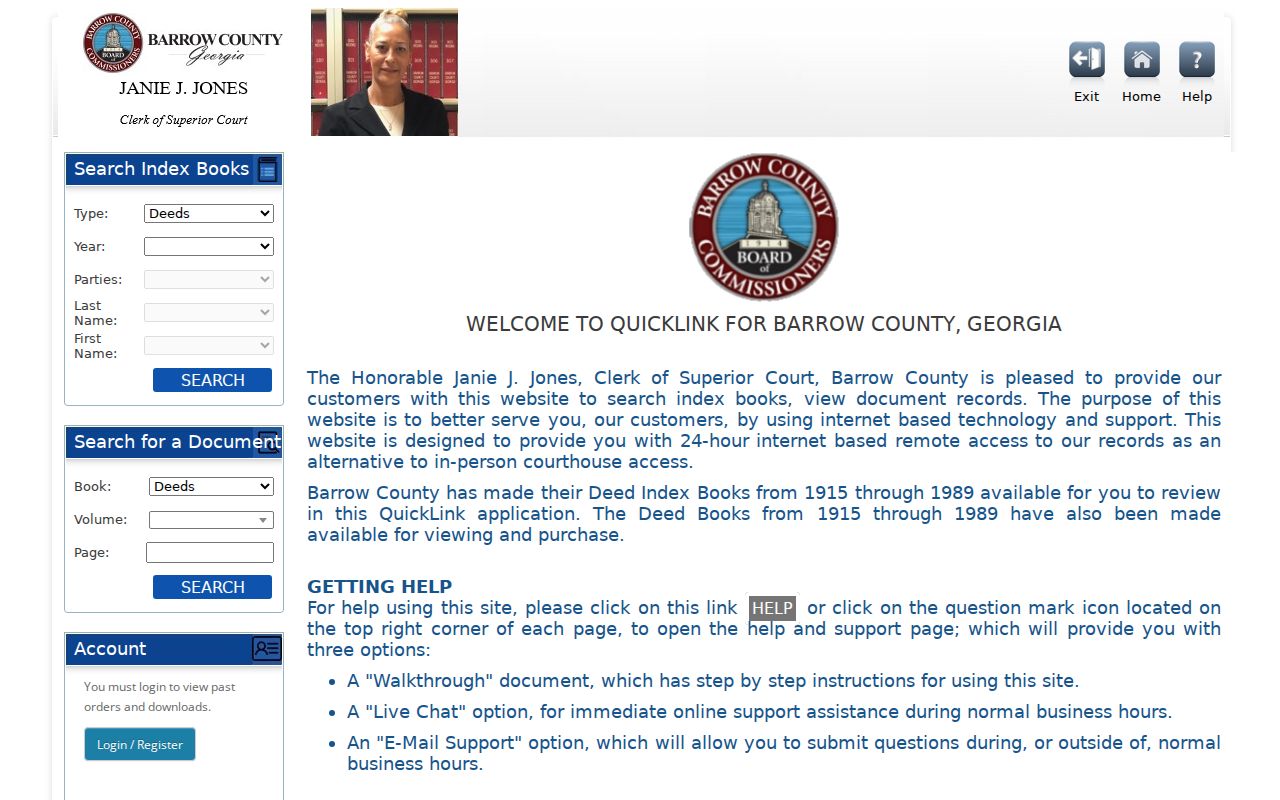
Party and book controls sit side by side on that page. A searcher can alternate name searches with exact citations while the deed chain moves backward.
Bridge 1989 to Barrow's Later Deeds
For later work, use the GSCCCA index. Its published baseline is at least January 1, 1999. Historical data may be added, and complete local 1990–1998 online coverage is not promised. Limited accounts search summaries; premium access supplies images.
Keep a chain log instead of jumping over the gap. The Clerk at 652 Barrow Park Drive, Suite B, Winder can direct a terminal or book search; call 770-307-3035 with names, dates, the legal description, and any citation.
Note: An online cutoff describes access, not the destruction or nonexistence of the underlying record.
Walk the Barrow Deed Chain Backward
Every Barrow County deed names the prior owner of record. Each transfer hands you the next deed to trace, and the chain holds up when the names and land descriptions stay consistent.
- Locate the present owner's acquisition deed with that owner as grantee.
- Copy every grantor and the precise description of the tract.
- Search each grantor as grantee to find the earlier acquisition.
- Match lot, subdivision, acreage, metes and bounds, and prior book/page.
- Repeat; at an online cutoff, continue at the Clerk.
- Grantor / grantee
- The conveying and receiving parties.
- Chain of title
- The connected sequence of interests affecting the land.
- Reverse index
- The grantor-side route used to find outgoing conveyances.
- Legal description
- The land description that outlasts street wording.
Preserve Names and Legal Capacities
Names carry traps. Search initials, middle names, former surnames, suffixes, spelling variants, "et al.," and entity punctuation, and test trustee, trust, decedent, executor, and administrator forms as the capacities allow. A life tenant and remainderman are not one owner. For namesakes, compare legal description, book and page, acreage, adjoining parcels, and dates before trusting a hit. The Georgia business search verifies entity names, not titles.
Follow Plats Through Parcel Changes
A deed chain can divide a parent tract. It can also combine lots, reserve an easement, or cite a subdivision plat. Plats matter here. Capture phase, unit, lot, block, roads, common areas, dedications, bearings, acreage, surveyor, and recording citation. Barrow GIS helps place the modern parcel. But the recorded plat and deed remain the legal-record sources. Winder's earlier Snodon, Jug, Jug Tavern, and Brandon names may appear in historical sources. Railroad corridors can explain rights of way. Trust the legal description and book/page over street text.
Corroborate Barrow Owners in Newspapers
Georgia Historic Newspapers lists Barrow issues from 1896–2025. The holdings include 107 Barrow Times issues from 1919–1921, 405 Barrow Journal issues from 2008–2016, and 468 Barrow News-Journal issues from 2016–2025. Legal notices, subdivision advertising, obituaries, and street names can explain an indexed clue.
Newspapers can mislead. An occupant is not always the owner of record. So prove every link through deeds. Winder Public Library provides computers, copying, and scanning, though its site publishes no complete directory-year inventory.
Continue Offline Through Clerk and Archives
The Clerk counter opens weekdays from 8 to 5. Terminal, deed-book, plat, and copy access all sit there. Older assessment cards can be requested from the custodian, and Georgia's retention schedule lists real-property record cards as permanent, though not every card is online. Bring every citation already found: index year, grantor, grantee, instrument type, book, page, subdivision, and lot. Keep requests narrow. Staff can identify the volume. They cannot conduct the title search.
Older work runs through the Georgia Archives guide, the County Records Microfilm Index, and FamilySearch. Log image numbers and collection titles with each finding. Deed books often lack street addresses, so compare the legal description with the next known conveyance, a recorded plat, a tax map, and adjoining-owner calls. No courthouse fire or flood story is on record for Barrow County, so do not invent a loss to explain a missing hit. A missed name variant, a predecessor county, or an offline index is the better first hypothesis.
How Far Back Barrow Ownership Records Reach
Barrow County property records begin in 1915. Anything earlier lives in Gwinnett, Jackson, or Walton deed records. Dig deeper and Georgia's land collections take over. The state archive holds headright and bounty-land grants spanning 1783 through 1909. A historic grant rarely matches the modern tax parcel. Boundaries and parcel shapes shifted over time. Before searching an old name, pin down which parent county held the land.
Old maps, plat descriptions, county-formation histories, and archive materials bridge the eras. They connect a grant and today's parcel number. When probate, a partial conveyance, or a disputed owner of record clouds the chain, professional title research is the sound route.
Lawful use. Former-owner research supports house history, estate work, and property diligence. Never use owner information to track, harass, intimidate, or harm a living person.